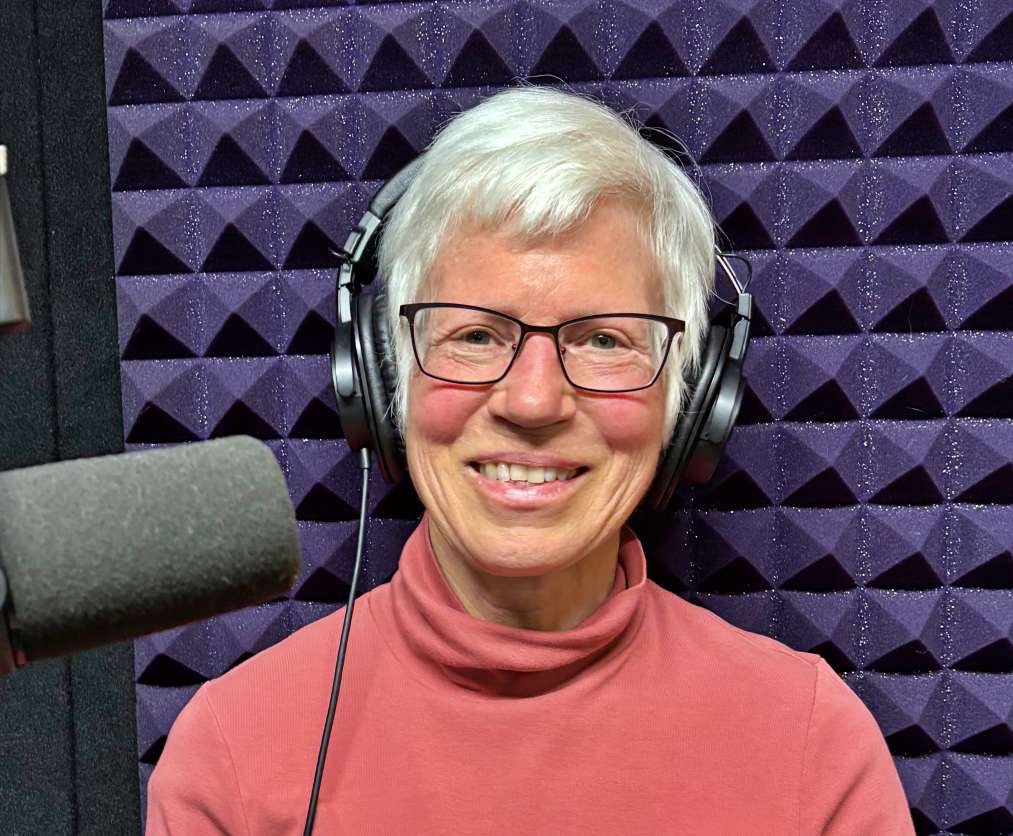
Hi, my name is Germaine Krase. My call sign is N6WTQ, November 6, Whiskey Tango Quebec, or the informal one is November 6, Wet, Tired and Queasy.
I started in the 90s when my husband and I had a dream of doing a long distance sailing trip. I’d already had a radio, first class radio telephone license with a radar endorsement, which then got, they got rid of that level and just made everybody General. So it was pretty easy to pass the written test. And I was also working for an electronics company and several people were hams there. So at that time, it was, you had to pass the code. And so it was easy enough to do the six words, I can’t even remember what the lowest one was. But when it came time to move on to the General, they said, well, why don’t you just take the Extra? And if you pass, then you get the General and you can come back and do the last two written tests. So it was multiple choice, which seems like that’s kind of almost semi-cheating, but it was enough that I was able to do the answers. I borrowed a program from my cousin’s husband called Code Quick. And that is a really good way to learn code because you don’t memorize dots and dashes. The Morse Code is actually a language. So you’ve got, mnemonics like A’s, say ah. And so that just makes it easy to remember and to respond to.
So I changed call signs after I got the General and the Extra. And in 1995, we finished fixing up the boat we were, had moved on to, sailed out the Golden Gate Bridge and took a left. We were going to go for several years, but it was a little harder with a two-year, two- and three-year-old than, for different reasons. You didn’t care where we were as long as we would stay there. And so there’s a big cruiser’s net and nets, plural. And then stateside hams would patch through phone calls if you wanted to speak to your family. And then also my dad had some friends at this point, they were up in Washington State, and I was able to contact their net. One person was in South Carolina, and the other two were up in the San Juan Islands. And I was transmitting from near Zihuatanejo.
And so I, came back and I ended up kind of a roundabout way, retreaded and went into nursing and joined the Medical Reserve. And they wanted everybody to be hams. I’m sorry, they had that license. And my nephew gave me a long-term loan of a HT. And then COVID hit.
And, but I was out hiking with some people, new people I didn’t know. And we were eating lunch. And I heard a radio’s repeater, kind of drop. Well, I looked to see where the sound was coming from. And it was from Ann Shores. And she was there with her husband and I said, “Oh, you’re a ham?” And she said, “Yes”. And I said, “Oh, I am too!” So then she invited me to come to MARS to that 2021 Public Service Kickoff.
So the big adventure was the very first hiking radio hiker that the two of us did, Muir Woods to Cardiac and back was a Double Dipsea. And it was hot. And it was smoky. And there were all these people that had not been, had done this race before, but just hadn’t been keeping up with their physical fitness. And as time went on, they were fresh as daisies coming to Mill Valley. On the way back, they started dropping, almost like flies. Kind of this, the scariest one was this woman who had gone off her asthma meds with her doctor’s approval, but did not stop to use her inhaler. So we had gotten word from the runners, and she kind of spotted her coming running towards us. She managed to make it to this huge redwood log, and drape herself over it. And I had to chase her to get the inhaler out of her fanny pack. And then she couldn’t get the, her breath out to get the breath in. But finally, with her friend’s help, she was able to take the breath in. At that point, the EMTs came down, gave her breathing treatment, and she went on to finish the race.
And I continued to Cardiac, hung there for a while, and then started down. But kind of the smokiness and by this time, the temperature is higher. And there were people with altered mental status. And one guy had told me, gosh, I laid down and thought if I slept, I would feel a little better. But, and I slept a good 20, 30 minutes, but I still feel bad. So we walked, we started collecting people at the base of those last steps going up to Cardiac. And another guy was just, his hand was just shaking. And he just couldn’t understand – he was late 70s or 80 – why he wasn’t able to do it. And eventually, we kind of collected them. And they eventually moved on. But there was one last person who was back to the final approach to Cardiac. Well, she had done the race before, was under a tree, could not walk more than five minutes without, throwing up. So EMTs came back down, lugging all this stuff, because they got to bring the oxygen and all kinds of stuff. And we managed to move her over the fire road from the Dipsea, and then also one of the Cardiac hams called the ranger, who’s not happy about it.
And, and there were lots of, there were lost hikers that thought they were going back to Stinson, but they were really heading for Muir Woods. And among those, there was also a family, sort of middle-aged kids and the slightly older parents, and the woman, the grandma, I guess, at that point, she was having some, some problems. So we had, waiting for the ranger, and the EMTs said, well, how would you like some free medical treatment? So they gave her a treatment and they were just thrilled. They thought we were literally were like, you guys are angels, dropped from the sky. And then finally the ranger came, loaded everybody up.
And then all of a sudden we start hearing fire engines. Well, finally, Muir Beach Fire Department shows up, Stinson Beach shows up and the National Park Ranger shows up and they’re kind of looking around like, oh, there’s nothing going on here. Meanwhile, Ann and I are standing there in our vest like what would we know? And, and then they heard the radio and so we kind of explained and then they drove off, which was kind of interesting seeing them do a U-turn with the fire trucks.
And, and she didn’t really want to, but Ann is very persuasive and talked her into giving us a ride back down. But then, that was interesting too, because we found out that the Dipsea crosses in and out of State Park and National Park, a number of times, but whatever the 911 covers everything. So nothing’s been quite as exciting as that, but we’ve done stuff like carrying some extra water since then, and I know what to look for. But because you’re not really supposed to give anybody anything. You don’t know if they’re hyponatremic or hypothermic. And so when I went home and, I was thinking, well, does a thermometer help? Actually, no, because it needs to be a rectal thermometer and it’s not going to be doing, you can’t get an accurate, you can’t get an accurate reading of somebody being over temperature.
So since then, I’ve done both rest stations. I did net control a couple of times, but I like the radio hiking and people there and the participants are very appreciative. And I guess the other exciting one was the Miwok 100K.
That was a couple of years ago where it was the one day typhoon and all the Easy Ups were blowing up. And I was a radio hiker for that going from Tennessee Valley to Muir Beach and then around past Pirate’s Cove, back up the Coastal Trail. And, especially the morning there, the rain was just going sideways and you’d have to actually hike to get behind where a wall would be cut in for a fire road to block the wind to actually transmit.
Now I’m up to five radios. I have the HF, so when you’re on a sailboat, then you use the backstay for an antenna. I got the HT from my nephew. The yellow fellow, the Cotre. I have a mobile that I haven’t really gotten to be very mobile yet. I still need to get a good power supply box to run that. And then I just got an APRS.
I guess I like organized group events. It’s fun to be part of something.
My son ended up getting his license, but that was for communicating. Back before you could buy drones or quadcopters, he built one out of parts when he was in high school. And he needed to communicate with a camera.
My husband isn’t interested. He was more like the physical aspects of the boat. He was a sailmaker and canvas guy. The reason my nephew had the HT is because he and his buddies in college would go out to the desert and shoot off rockets.
I guess for me it’s more a tool and less on the air social. That social part is with the club members or when you meet somebody else that is a ham.
Recorded on April 23, 2026 in Mill Valley