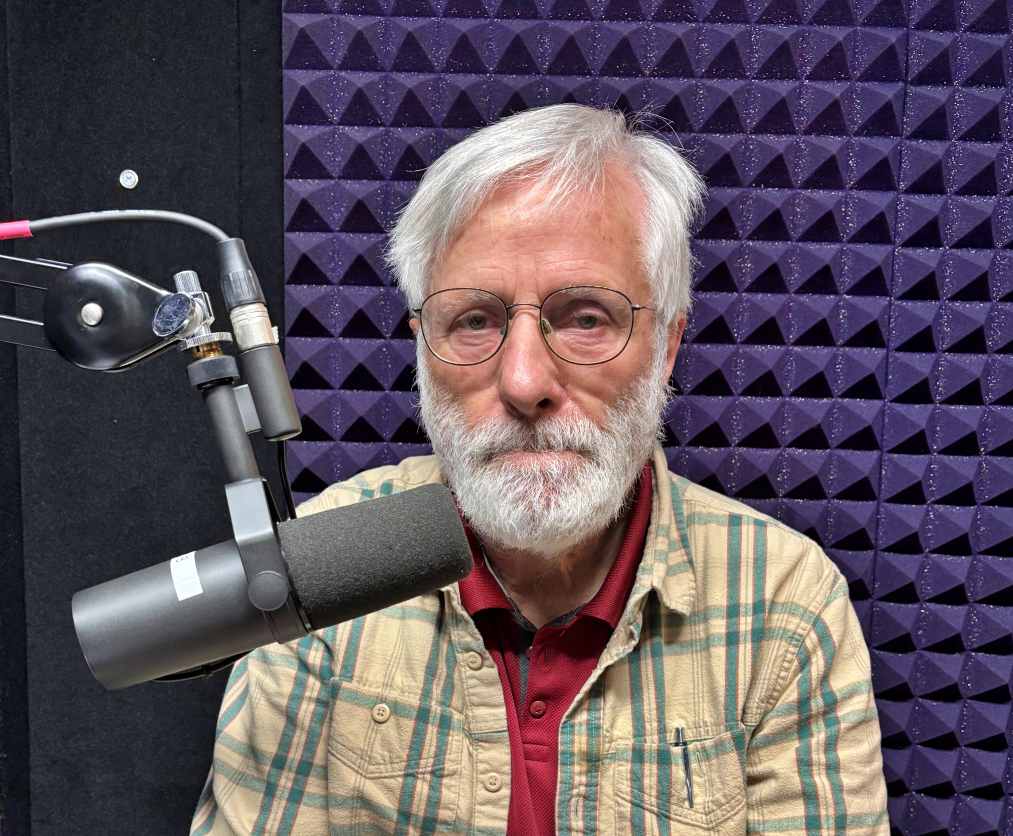
My name is Rob Rowlands, NZ6J.
We lived on a remote farm, not a remote farm, but on a farm in New Zealand where there wasn’t much happening. So ham radio was a window to the world. My probably four or five year old first image was going into my dad’s shack and seeing the transmitting tubes that glowed when the carrier was up. So he was doing CW. You’d see the glow on the transmitting tubes coming and going. Or if he’s on phone, you’d see the brightening, which for a four year old was pretty exciting. And of course, my path was to follow him into getting licensed in my teens and studying electrical engineering at university and ending up working in the profession as I have for 55 years, which I think is the ideal entry into electrical engineering.
One of the things I did do years ago when I was in Antarctica for a summer was I ran the ham radio nets from the three stations I was at in Antarctica. The Antarctic Research Program, the American Antarctic Research Program encourages hams to set up stations in all the remote sites for obvious reasons. And in these days, which was during the Vietnam War, the people that were sent to Antarctica were people who were sent there rather than being sent to Vietnam. So we’re talking about Seabees, Navy Seabees and people like that. So running phone patches back to the United States for them to talk to their wives and girlfriends and whatever was an activity that required licensed hams and there was an absence of licensed hams despite the excellent equipment we had. And so I stepped in and used to run phone patches and stuff simply because there was nothing else to do. So fun stuff. But dealing with the vagaries of HF and all that, it’s pretty interesting. I’ve been on sailboats where ham radio has been a link to the outside world that we didn’t otherwise have through the marine radio system. So ham radio was a way of keeping sane while you’re sailing across the Tasman.
The interesting thing is in trying to explain what we do, the profession that’s most open to explanation is the legal profession. There are more lawyers that I’ve spoken to that glom on to what we’re about than any other profession. Because lawyers, A, actively listen, and B, have no hubris involved in not knowing anything and being prepared to ask the question. Whereas most of us tend to sit on our haunches and try to extrapolate upon what little knowledge we have on whatever topic we’re dealing with. So it’s pretty, yeah, so it’s interesting. Some of my best friends who are lawyers are people who best understand what I do. I met a young lady yesterday when I was out hiking who asked what it was for, and she’s 20 years old and smart as a tack. She’d never heard of it. The fact that ham radio is so unknown by the public at large, but I explained to her what we did with it and she was sort of in five minutes up to speed on what needs ham radio thinks it has to address and could see the value in what we’re doing. But the public at large doesn’t have that knowledge. The public doesn’t understand that ham radio requires a license. They think they just go and buy a radio and talk, which indeed you can do with GMRS and MURS.
I’m frustrated by radio ham’s lack of curiosity. The majority of radio hams are quite happy staying with FM radios, handhelds and home FM radios, and not necessarily interested in going outside their comfort zone. This is exemplified by when we go to public service and try to do something different, like using APRS or DMR, there’s not just blank stares, which can occur, but almost a reluctance to go outside their comfort zone. That’s an understandable personality trait that most people have, but I personally like to be a little bit more curious. The interesting thing we have on public service is the number of times people pick up a radio that’s supposed to be used for tracking and stick it in the bottom of their pack without realizing that there’s no propagation from the bottom of a pack. Those kinds of things. And this just requires education from us.
People don’t realize that they’re allowed to listen to any frequency except what used to be encrypted cellular signals around 800 megahertz. I think there’s no use there of encrypted cellular anyway, but basically people don’t realize the complete capability you have to listen to anything. It’s not always the case in other countries, like I’ve worked in Nepal quite a lot. And in Nepal, people are terrified of the government and terrified that if they listen to something that they’re not supposed to listen to, there’s going to be a knock on the door. And the Nepalese government has its own rules, and you could argue that perhaps they might be justified in doing that if they’re trying to control terrorism. But it’s an interesting aspect.
The ether of the radio waves are open to everybody, and I’ve always been promoting that. And I think anyone who’s going to work in radio frequency engineering needs to understand what use is currently being made and what use might be made in the future.
And I teach a class at Sonoma State at the moment on RF test and trying to get these people interested in the frequency domain in general and ham radio in particular is sort of a target of mine, getting people to either tune into an SDR at Point Reyes or have their own SDRs on their computers and getting a sense of the frequency domain, what’s there, what services are available. One of the things I was working on last Wednesday in my class was most people did not realize there were international broadcast channels on HF. And so we tuned the Point Reyes SDR into one that was actually in English, believe it or not. And it was a religious station. And religious stations are using HF to proselytize. You also get propaganda stations from China and other countries that feel the need to share their opinions with the rest of the world.
The other anecdote that’s interesting that may be of historical interest is Doug Slusher, was a stalwart of the club for many years. And he was up at Barnabe with his large SUV trying to make the last 100 feet on a moderately degraded road up to the lookout, when he put his car in reverse instead of in forward and went backwards over the edge. And so those of us who knew Doug were sitting, oh my god, this is what’s going to happen. So Doug was immobile. And so he was stuck in his truck, which fortunately had run up against a boulder halfway down the hill before he ended up with oblivion. And so his truck was jammed against this boulder with him sitting there belted in. And so he got on — I assume he got on the repeater or he may have just called, I don’t know. But that’s not the important thing. The important thing is he got winched — the truck got winched out and he stepped out. And the truck was undamaged and Doug was undamaged, thank god. But that was an example where someone was going out to work on a volunteer radio assignment and put himself in potentially a fatal position.
It’s all about having fun. I mean, there’s very little visceral about this apart from the fact that sometimes people need us, but mostly it’s just having fun for ourselves. So to be honest, our public service program is there to help the clients, the organizations, but in part, I think most of us are there to enjoy ourselves and try to find some meaning in our otherwise meaningless hobby.
Recorded on March 6, 2026 in Mill Valley