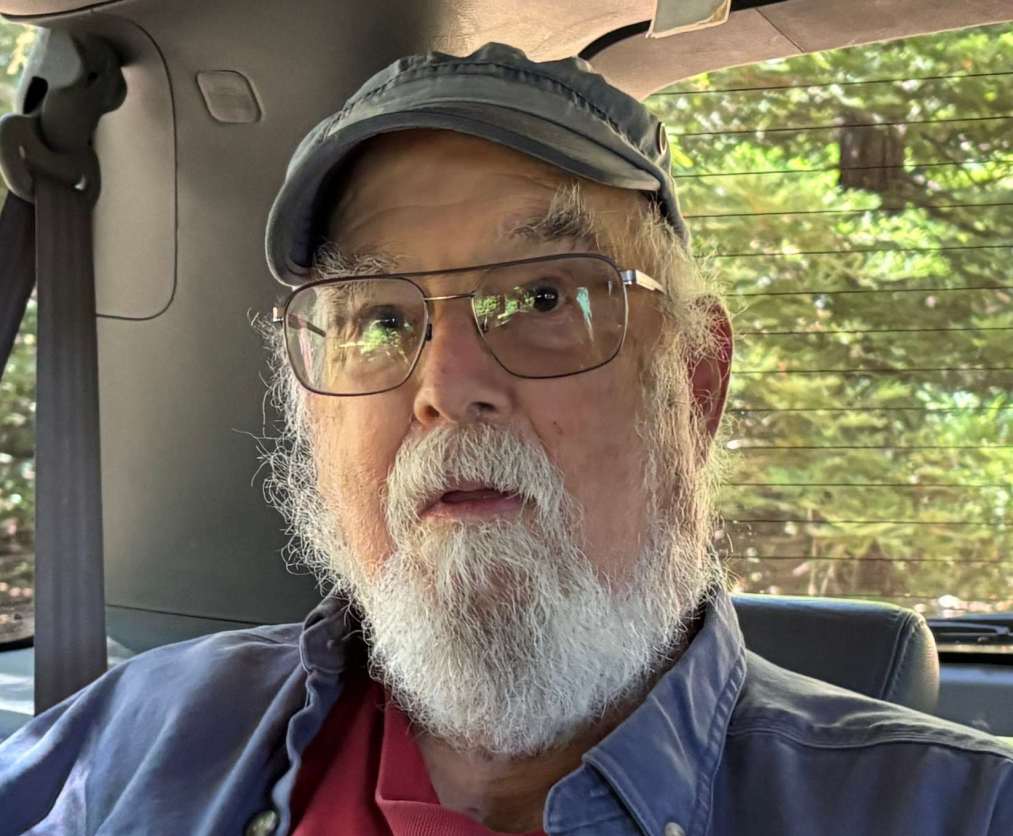
My name is Peter Otis, KI6SZF.
As a kid I was kind of a nerd, and I always liked electronics. And even as a child, my parents supported that by getting me these little breadboard kits. I’d put together, I remember, you know, making a crystal radio. I lived in South Bend, Indiana, which was 90 miles away from Chicago. And Chicago had a really powerful station called WLS, which is still there, I believe. And to my amazement, I did this little breadboard thing, and I got, in my earphones, WLS. I was blown away. I was probably ten years old or so.
I used to take Electronics Magazine, and I remember the transistor coming out and being a big deal. And the old Raytheon CK722 transistor was one of the first you could buy. And I think it cost like $7. A lot of money. And then we had the little, the photocells. International Rectifier, I think, made them. B2M, I remember the designation. And this kit that I got out of Electronics Magazine had a schematic for, you get four of these solar cells, and you get the CK722 transistor, and the others, the little coil and all that. And you get a solar-powered radio. And I did it. I built it. And I put it in a little tiny wooden box. And my father was absolutely blown away. Now here’s a man that was born in 1892, before they had cars on the road. My grandmother thought if you go 60 miles an hour, your heart would stop. But he was blown away by this. And so I’ve always been interested in radio.
However, I don’t have a mind for code very well. I have learned over the years, if you’re a good musician, music is very much like code. And my wife can play the guitar by ear. I remember in school, maybe fourth, fifth grade, we were given a kazoo. And the teacher would blow on this little pipe. And she said, now that sound is C. And everybody goes, okay, all right, and they blow on their little pipe. And she’d blow on her pipe again. Now that sound is D. It sounded all the same to me. I couldn’t tell the difference. And I think she basically gave me a passing grade kazoo, even though I didn’t know which end of the damn thing to blow in. Code was something that was challenging for me. So I kind of went along in life.
Many, many, many years later – I had a really great job working for the Regional Water Quality Control Board as a staff environmental scientist. And part of that work was working with these basically submersible computers that you could put in a lake or stream or water. And they would record various aquatic parameters, marine parameters, whatever. And then you would take them out, and download the information into your computer. In the process of doing that, I was working with the Coyote Valley down in the Peninsula Resource Conservation District. And I met a guy who was a ham radio operator. And I talked to him because I remember seeing his call sign. And he says, hey, Peter, they no longer require code. And I go, no kidding. He says, yeah, they no longer require code. So yippee skippee, I went out and bang, I got my Novice right away. Can’t remember exactly when that was. And I got my General. I met Jerry and Doug with RACES. And I was invited to join RACES.
And my wife was considering a position in France. And also, I was elected as an officer in RACES, which required an Amateur Extra class. As did going over to France and getting an International License and all that, you had to be an Amateur Extra.
So I loved academics – always loved studying. And so I got my real thick radio book and concentrated on, you know, Amateur Extra stuff. Jerry called me and said, hey, Peter, we’re having an exam this morning. And I just wanted to call to see if you wanted to show up. And I said, well, I’m not totally ready. I’ve been studying, but I’m not. He says, oh, come on down and take the test anyway. And I said, well, all right. And it just so happens that I had been studying that morning antenna theory. So I went down, I took my test, and I’ll be damned, that’s what was focused on the test. And I got my Amateur Extra. But that’s how I became a ham, because I didn’t have to do code.
When I initially got my ticket, I was a lot more active on HF than I am now, but I absolutely loved talking to people that, I mean, that were like in France, in Japan, and we can hit Japan pretty easy here. I remember talking to hams in Japan. I was blown away. I had 100 watts and a wire, and I’m talking to this guy in Japan.
Western Siberia, Peninsula, Norway, England. I mean, I had incredible, I’d run downstairs and say Barbara – Barbara, I just talked to a guy in Wales. Where the hell’s Wales? So I get my book and I figure out, oh, Wales is part of England. No, it’s not part of England. Don’t say that. But I learned a lot of geography about ham radio, and I still think that’s very valuable. I know where Heard Island is, for example. You know, whoever heard of Heard Island? But I actually got a contact. They had a special event at Heard a few years ago, and I was with my friend Lyle Lewis, who has unfortunately passed away.
But he had a pretty big rig and a tower and a three-element beam and lived in Nevada. And he says, why don’t you come over and see if you can, you know, with your wire, you can’t hit anybody like down there. But with my thing, you might be able to, you might, might possibly be able to hit Heard Island. And so I said, okay, you know, we, you know, so I went over there and he dialed him in and he got him. And he says, now, don’t be discouraged if you can’t get him. I mean, you know, it’s quite a ways away. But don’t, don’t worry about it. So he says, okay, go ahead, you’re on. So I called him and bam, I got a contact right away. He couldn’t believe it. They came right back. And so I was in the log at Heard Island. And much to the absolute amazement of my friend who thought I’d be there for 15 minutes trying to get through the pileup. So that was always, that was a very exciting time.
I enjoyed working RACES. We never really had a disaster. I joined after the big fire they had out in Point Reyes. So I never, you know, fortunately, we never had a disaster. We had a few floods and stuff like that. But I enjoyed the tabletop exercises and pretending, you know, there’s a lot of pretending. And I thought those exercises were very illustrative, a lot of fun.
And I liked it. And then another thing I really enjoyed was KPH. And KPH is still there. And Richard Dillman, big shout out to him, still runs KPH the Night of Nights out at Point Reyes. I strongly recommend anybody interested in radio to go out there. It is an absolutely fascinating museum of history. That’s where they got the first telegram about Pearl Harbor. It came through KPH. And the history of KPH, the history of West Marin, the history of radio in Marin County is absolutely incredible. Bolinas and Point Reyes were the two stations back in the old days with these big spark transmitters. They couldn’t put them close together. So they had to put them miles and miles apart.
So reading the history of these gigantic spark transmitters and why they call radio men Sparky, or radio people Sparky. Why they had to be in a shack – because the transmitters made so much noise. Nobody wanted to go out in the shack. And then learning the history of Denise Stoops. She was the first woman to ever get a job in a man-oriented place like a radio. She could send code.
If you knew code, which I did not, but if you knew code, you could always identify her because she had a very distinctive way of sending code. And I remember, you know, you can go on the net now and listen to down the YouTube stuff about her, but people that were really into code and could, oh, that’s Denise. And I remember Dilman saying that you could hear her, even if you were in the shack, she wore bracelets and they’d jingle and jangle when she’s sending code.
So anyway, KPH is a great place to go. Interesting history. And Marin County is a very, very important place in radio history. Marconi did one of his first trans-Pacific transmissions from Marshall. So worth every ham learning a little bit about the history of our sport.
I never really got into digital stuff, it’s just not that interesting, because I value what we’re doing now, talking. Now, if our conversation was reduced to a couple blips on the screen, big deal, you know, so I got a contact. I told you earlier about how jacked I was to get Heard Island, but if that was nothing more than a code on a screen, or looking at the waterfall, and you know, seeing something, you know, and I understand the value of this kind of communication in disaster response, where signal noise ratios are really high, and you got to get information across, but for me personally, FT8 and all that stuff is boring.
Ham radio has saved the day. Take a look at the history of how we helped in the various hurricanes in the East Coast, how we can set up a station. I can set up a station, a wire, provided I have all my stuff, in probably 30 minutes or less, maybe. And I could put out 100 watts on a wire. And if the atmospherics are good, I could talk anywhere. And I could set that up almost anywhere. And to be able to do that, I think it’s kind of cool. Now, I don’t necessarily do it, but I can. And that’s one of the things that I liked about EMCOM.
We set up using military, what’s called NVIS transmission, a radio station in about 15 minutes that could talk easily throughout the state of California. That’s a big deal. And hopefully, I won’t be alive when the big one hits. But if it does, I mean, those types of communications, those short-range communications will be very important. And these are all things that anybody can learn. And you don’t have to be a PhD in electronics to learn this stuff. You just have to have the interest.
The friends that I have developed through ham radio, hams seem to have an intrinsic ability to want to help other people. It’s a community that is unlike any other community I’ve ever been involved with. I would imagine I could go up to Shingletown right now. There’s a ham up there that said, anytime you want to stop and have, you know, have coffee. I only know this guy on the radio. But he’s reached out, you know. And that’s an incredibly interesting aspect of all. As I said, I’ve never met a ham that was a recluse because I don’t think you can be a recluse and a ham at the same time.
Recorded on June 27, 2026 @ Field Day in Novato, CA