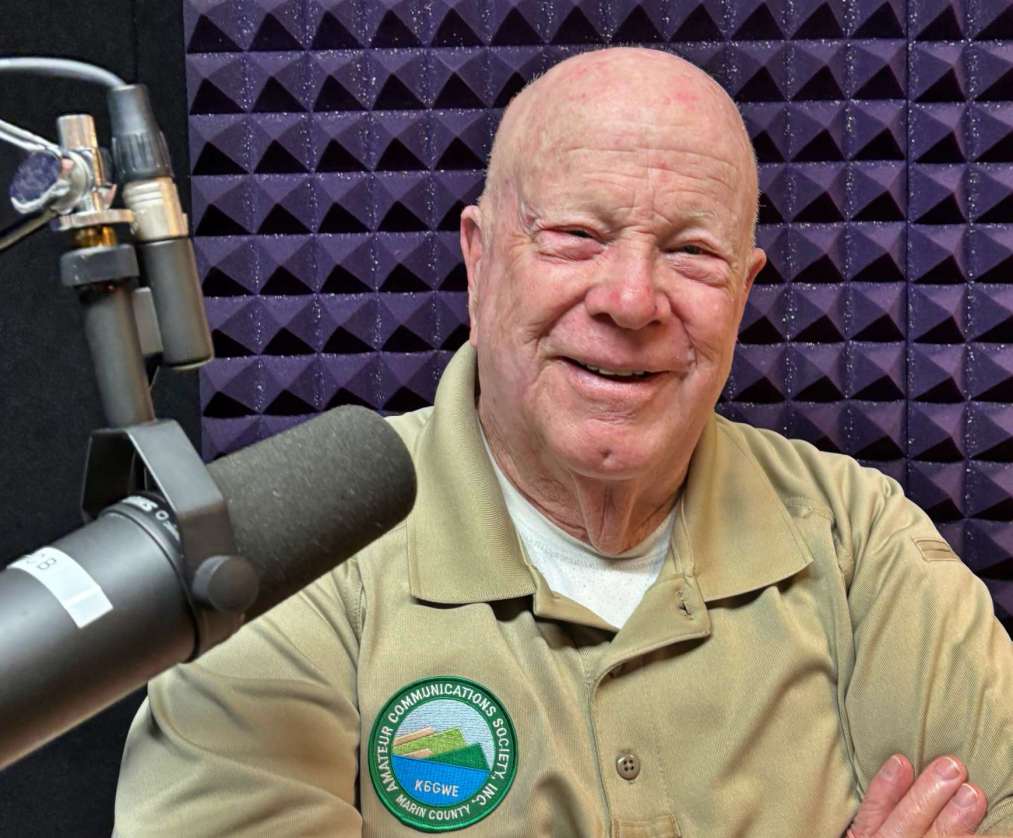
I am Milt Hyams, KM6ASI.
Well, my father was an electrical contractor, so he started me right off as a little guy learning about electricity. As I got to be older, like about ten, I thought I knew much more about electricity than I should. And so I started experimenting, and an uncle gave me an old Zenith radio, one of those overseas things, but without the cabinet.
So I got to see all the tubes and components and so forth, and I found by tuning the short wave side, I could hear surprisingly large parts of the world that I’d only heard of as a little guy. So I also, when the radio wasn’t on, would turn it over and take a look at all the components underneath. I thought, gee, that’s kind of cool how all that stuff combines to produce sound.
So my father started giving me lessons with regard to electricity and the concept of circuits, and I can remember him telling me that the root word for circuit is the same as in Latin for circle. So he said that the electrons would essentially flow in a circular pattern and come back. I knew all I needed to know.
So after having taken a look, I thought I would make my own circuit. And I got a piece of old siding from our house, which was relatively new at the time. I got some number 14 bare copper wire and proceeded to make a circuit.
And that was all well and good until I decided to put a cord with a plug on the end of it and plugged it into the wall and caused a major bang, popped a fuse, and immediately inspired my father’s ire. So he should have seen it coming. The piece of wood wound up having my circuit, if you would, etched in it because the copper got so very hot.
So he said, enough of that, threw my circuit away, and went out and bought me a Cub Scout crystal set kit. I made the crystal set kit. And over the following years, Christmas or two later, I got a Hallicrafters S-38C.
That was my first shortwave radio. And I made a few things in between. And my dad, who was a yachtsman, probably a boater is a better description, bought a boat that had a very nice ship-to-shore radio on it.
Back in those days, ship-to-shore was on AM. The requirements for having a shipboard radio at that time is you had to have a station license, which was complete with a call sign, and each operator had to have a license. So he knew I was interested in that, and I think I was 12, 13, probably 13. I was 13. The deal was that he would get the station license and I would be his radio operator. I thought, oh, that’s so cool.
And so I eventually applied for it and got my first radio license, which was a restricted radio telephone license in 1957. And, as it turns out, where we had our boat moored in San Rafael, the neighbor immediately across the dock from us was a ham. And we were having trouble with the radio, even though it was an excellent radio.
It was a Kaar, a K-A-A-R radio. We were getting feedback problems on the RF side, going out on transmissions. So I thought that I had kind of a Pyrrhic victory, that I had a license, but the radio wasn’t working right.
I went and complained to the fellow across the dock, and I said, oh, let me take a look at it. So he came over and popped the hood on it and found, he said, oh, I think I can fix this, and went and put an RF choke on the final. And the problem went away, and Molly, who was under the hood, found that it had an 80-meter crystal for a ham in there.
Obviously, one of the reasons probably for the feedback is that the prior owner had been a ham and had tinkered with it somewhat. Anyway, he fixed it, took the crystal, gave it to me, said do not put that back in until you get the appropriate license. I think I still have it at home, for that matter.
And then started getting books on amateur radio, and I can recall even calling CQ over ship to shore, much to the puzzlement of other yachtsmen out there. Jumping ahead a number of years, graduated from high school in 60, went on to USF, and at USF I joined the ROTC program. So I became upper division ROTC, which means I was heading for my commission. I went through all the training on that. At your junior year, you apply for your branch assignment at the end of the junior year. And went through an interview with a professor of military science, and I think I had applied for Armor, Signal, and Quartermaster in that order.
To do so, you had to fill out a resume. And they wanted to have all of your interests and qualifications and so forth, and if you had any kind of license to do anything, including hunting and fishing. And as a matter of fact, hunting and fishing would be a clue to the branch people that you liked the outdoors, and they could see you with a rifle in your hand out in the woods as an infantryman.
But I had put down, among other things, my restricted radio telephone license. And he went down and skimmed it, and he didn’t get any further than that, and he says, Hyams, you are a cinch to be selected for Signal Corps. Finding somebody with any kind of qualifications going in is rare, especially for people that are not electrical engineers.
And so it turned out he was right. I graduated from USF in 1964, went to law school at USF, and finished law school. At the end of law school, the JAG folks came around, talked to everybody that had gone through ROTC and had been having their commissions.
Although I was commissioned, interestingly, on June 6, 1964, the 20th anniversary of D-Day, I never served any active or reserve duty during the time in law school because it was deferred. The Army was operating under the assumption that this was prep time on my own nickel to become a JAG officer. Well, the JAG folks showed up and tried to recruit me, and I respectfully declined branch transfer to JAG.
And they said, Why do you want to do that? And I said, Because I happen to like Communications. They said, Okay, you’re probably headed for Vietnam. And I said, All right, so what? I’m ready to go.
So it turned out they were right. The one thing I wanted to do is to learn a lot more about radio, and I applied for radio school. But at that particular point, because I had been in active reserve, I actually got promoted while I was in law school to first lieutenant. And the personnel and administration people said, Hyams, you’re not going to radio school. We don’t send first lieutenants to radio school. You’re actually promoted too high for that.
You’re talking about a job, as far as lieutenants go, for a second lieutenant in the radio platoon or something like that. And if you’re going to get command of anything, it’s probably going to be a company. Well, I went off to Fort Lewis, and they were right again, that within three weeks to a month after I got to Fort Lewis, I picked up command of a signal company.
It was a radio cable construction, which was a telephone installation that was tactical. And then came down on orders for Vietnam, and I was assigned to a battalion that was on post that was getting ready to deploy as a unit.
So I went over and became the commander of that company and had a couple of platoons, even though it was a headquarters company. And that gave me an opportunity to get my hands dirty a little bit. But one thing I was counseled on every inch of the way is the equipment you sign for with your company as yours until you assign it to your sergeants.
Then you leave it to your sergeants. We didn’t want to have our officers get under the hood on signal equipment. And then deployed to Vietnam, got yet another company in Vietnam. And it was actually similar to the company that I commanded in Fort Lewis, except that we did commercial installations, just the same.
You go outside and take a look at the heavy cable construction. That’s exactly what we were doing. And we would take our service all the way from Dial Central right down to installation at whoever our customer was.
It was generally not in a hot area because you don’t put up standard telephone poles and cables and have them last very long. And a matter of fact, even where we put them up, we were constantly having to do repairs. Finished my obligation in Vietnam.
Then spent the last three months on active duty at the Presidio. And I was mainly shuffling papers, although I finally got some introduction through the MARS station up there. I had a lieutenant that worked for me that was the MARS officer.
And I think in his tour at the Presidio, he might have gone up there two or three times. Then finished my active duty obligation and went into the reserves. My first assignment in the reserves was, again, a company commander, but it was a radio broadcasting company for a psychological operations battalion that would be putting out propaganda.
And what we would do is actually literally run a high-powered commercial-style radio station. And most of my troops were reservists from the broadcasting community in San Francisco. And eventually worked my way up through the chain.
The reason I didn’t become a ham up to that point, the ham that was the neighbor at the yacht harbor, tried desperately. We went over the technical stuff, and I didn’t have any particular problem with novice level and technical. But I had a terrible time with CW. I guess a tin ear, and I had a very difficult time discerning not necessarily the dots and the dashes, but the spacing and the flow.
And I would constantly get it screwed up because I would stop to think about what the last one was, and there would be two or three letters that went by, and I could never straighten that out. So being in high school at the time, I was just starting high school, became secondary consideration, so I bailed on that. One of the interesting things, too, when I was commanding the broadcasting company, we got our operator, the folks that were actually on air, licensed with FCC entry-level commercial broadcasting license, which being the boss, I didn’t have time to take the class to do it, which I regretted.
But things passed over the years, and life got in the way. And when I retired, I went to the DA’s office. I was in the DA’s office in Marin for just about 28 years and in San Francisco for another seven.
And then when I retired from everything else, I was a volunteer instructor in my oldest son’s honors government class. At the head was the head of the social studies department for Incline High School in Incline Village, Nevada. And he still lives, for that matter.
He had a competitive constitutional government course, which I liked Con Law when I was in law school. So he recruited me, and I did that for 14 years. The course of the school year also is usually simultaneous with the winter season, so going over the mountains in the snow was a bit of an adventure. And finally, after the ‘14-’15 year, that is 2014-2015, having spun out twice in that year, I thought I’m pushing my luck having done that from 2000 up to that particular point.
I retired from doing that, and time was weighing heavily on my hands. So I started going back and looking at the possibility of learning CW and becoming a ham. And much to my absolute joy, I found that in 2007 that CW had been dropped as a requirement.
I thought, no problem. So in 2016, I got my license and did it one step at a time. I think by May, I was an Extra.
So it’s, what, 10 years ago. During that time, I joined the club and also had a friend from my youth who we had headed our separate ways but happened to rejoin at a meeting. Dan Dufficy.
Dan Dufficy was essentially the architect of the Simulcast system in Marin. And so we renewed our friendship very quickly. And so he tried to teach me everything that he knew about the repeater system because what he wanted to do, I think, is have a successor. And he knew me well enough that he thought I could do it. Well, technically he was wrong, but that is from a technical or engineering perspective. But unfortunately, he had the poor judgment of dying before he had accomplished his mission.
But nevertheless, I wound up inheriting the repeater in the technical committee. And so having me as the head of the technical committee was a poor choice, but I was the only one that was willing to do it. So that’s how I got into it.
It’s kind of like being in the Army, serving your time and not getting involved in combat or getting shot or something. It’s always really good news. And serving in public service is a very similar situation.
My first Dipsea, a veteran who I’m not going to name at this particular point, but had been running a Dipsea as long as I had aspired to be a ham, was having problems on the run. And I was up at the top of Steep Ravine when a number of people came by to say that this person, they used his name, was having problems. So I called down to report that.
Well, do you have his bib number? Nobody was interested in his bib number because it would be like Babe Ruth was having trouble at second base and nobody would care what his number was. It was Babe Ruth. So I said, I don’t know. I guess we have bureaucrats too. I tried to find that out. So anyway, eventually the race was finishing.
The sweep came through at a snail’s pace, escorting this fellow down. And he says, I’ve got it really clear. So what I’ll do is I’ll babysit him.
Can you get him some help? So he was sitting in front of me and had no trouble with the bib number. And so I called down. And virtually, it seemed almost instantaneous, but probably no more than five or six minutes, the Stinson Beach Fire Department showed up at the top of the stairs at Steep Ravine.
And they’re on a first-name basis with this guy, and I don’t know who he is. He’s just from a hot rock.
So they had their own radio back down below. So they got in a discussion and they said, what we want to do is call search and rescue in here, and we’ll work out how we’re going to get him out. I called them to tell them because we, as with the Dipsea, we’re operating out of what is the command center, and that’s where 9-1-1 for Dipsea goes, that’s the unusual thing about our events.
You don’t use 9-1-1, you call into net control because net control is about ten feet from 9-1-1. Anyhow, Search and Rescue came down the trail, and I’m mainly a spectator on this whole thing. The runner was trying mightily to talk the lieutenant from the fire department into letting him continue down the hill.
And he said, I don’t think so. And what was apparent was he was dehydrated. It was a particularly hot Dipsea, it was about 78, which is scorching up there for a Dipsea, particularly that hour of the morning.
And he probably hadn’t taken enough fluids. So a few minutes later, Search and Rescue comes down the hill. And the fellow that was in charge of Search and Rescue gets in a discussion with the fireman.
And they said he wants to head down, a lot of body language, very negative body language. So they said, the fireman says, Russ, his first name is Russ. Russ, what we’re going to do is take a vote, and you get a vote, as to whether or not you should be able to continue down the hill.
I said, yeah, no, I definitely want to go, Russ says. And I said, okay, Russ, I’m going to have to vote against you, because I’m worried about you, you’ve gone a little bit too far. And your vital signs are kind of squirrely.
And he says, Russ, you’re of course voting to go on, right? Yes, all right, Russ, it’s one and one. Then he said, looks like the Sheriff’s representative here is going to make the decision. And he says, well, what do you think? And the fellow from Search and Rescue nods, no.
Well, then the real debate took place. And that is between the Stinson Beach fire folks and the Sheriff, as to who was going to get them out, because the choice was to call for a gurney. They didn’t have a gurney at that point, to either come up or come down from Cardiac.
So they decided between themselves that probably Cardiac was the best solution, because they have a single-wheel gurney. And so they called back and called for a gurney. And probably it was maybe another five minutes, two guys that look like linebackers for the 49ers come chugging down the trail with a gurney loaded up, Russ.
And he was on his way. Then my adventure started. Well, what happened to him? So I told them that Search and Rescue took him off, but your guys ought to know that, because they were talking all the time here.
I said, well, we’re starting to get questions from the family as to where he’s going to be. Well, I said, you’re still probably in the best position to know that. And apparently they hadn’t made up their mind till they got back to the ambulance at Cardiac that they were able to get some fluids in him, and they wound up turning him over to the family at Cardiac.
This fellow was a big enough deal that when he ultimately passed away three or four years later, had a big spread in the IJ.
Ham radio has gone through kind of a metamorphosis. When I was a kid, the prospect of being able to talk around the world from your house, your bedroom or your radio shack or whatever it happened to be, was downright exciting. And I was interested in electronics, probably at my father’s inspiration.
He actually had no concrete interest in amateur radio, although one of his best friends’ picture is on the wall of the original class at Marin Amateur Radio Club. And he, at that time, was the head of telecommunications in the County. And because of that relationship, he would get my dad to do a lot of the wiring work for him.
So my dad had kind of a peripheral interest, so he encouraged me to look into it. And I was, I think, probably kind of annoyed that as I got older and into high school, that I didn’t spend more time doing that than other things that high school kids do. Then as things moved on, certainly being in the military, I found out how important communications is.
And my whole perspective on it changed quite a bit. It was more than just an adventure. It was to facilitate doing your business, whatever it is, whether it’s being engaged in combat or just logistical support or whatever, how important it was.
And when I went into reserves, many of my colleagues were all combat arms people. All of my commanders were infantrymen, and they always looked at signal officers and anybody who was in infantry or, for that matter, armor or artillery with a considerable amount of disdain because they were the pointy end of the spear. And I was quick to remind them that how many times was your life and the life of your troops at stake when you got on the radio and called in for artillery or airstrikes or whatever to bail you out. Imagine, we wouldn’t be having this discussion if it wasn’t for communications.
And one of the great ironies is that one of my reserve bosses, who became a general, ultimately became, as a reservist, the desk C4 for the Army. Desk C4, 50 years ago, would have been the deputy signal officer for the entire Army. And he was an infantryman, which rubbed me the wrong way a little bit, so I got as much as a colonel can do to harass a major general.
I said, you know, sir, over the course of the years, you gave me a lot of crap about being Signal and the role of Signal, and now the shoe’s on the other foot. And he said, you know, you were right. And as a matter of fact, because I was such a proselytizer for communications and the importance of communication, when I retired, he recommended me for an award, so that was nice.
Unfortunately, a number of the misconceptions about ham radio probably really aren’t misconceptions. They’re old folks. The view that I had back as a kid, they were old folks playing around with old World War II surplus equipment.
Well, the surplus equipment’s long since gone, not totally since gone, because we have a number of colleagues that still like to play with that stuff. But a bunch of old dudes just playing with newer equipment. So there’s been a slight revision in my view on that.
One of the great disappointments is that there aren’t more youngsters interested in that, because if your view of amateur radio was the same as mine going in, that is, you could talk around the world. I’ve had a number of people tell me, well, I could do that with my cell phone, which is true enough. But the integration of data into amateur radio is, I think, the wave of the future. It’s not necessarily for me, mind you, but nevertheless, that’s something we have to pay attention to.
You’ve got to be careful with the integration that we don’t dig ourselves into a hole and forget what our real mission is, and that’s to communicate. And when the experimentation and the communication meet at the end of the day, communication has to win out.
Why should someone explore ham radio? It’s going to really depend on what their interests are. If they’re interested in science and technology and so forth, that’s a natural, because for one thing, getting into amateur radio, it’s a much broader spectrum than simply sitting down at a microphone trying to talk to somebody in China, that you have opportunities to do lots of things, and then you wind up getting your license. All you can do is get your fingers wet in all of them and move your hobby in the direction that you want to go.
It’s not going to force you in any particular direction. That’s actually one of the real surprises that I had. In terms of technical stuff, one of my great ambitions, and that was one of the reasons I went into amateur radio, and because of the demands of the club, I’ve never been able to do this, is I always wanted to emulate my very first Elmer, to be able to go under the hood of a radio and say, that’s the problem. It never happened, and at this particular stage in my life, it’s likely not to happen, but that’s really turned me on to it.
With younger folks, they’re probably more interested in the data side of it, and integration of computer systems into radio communications. With satellites, the thing that really gets little kids fired up, being able to talk to a space station or something like that, that’s something that we need to take advantage of, and unfortunately, because of the demographic for our club, we don’t have too many people that are into that.
We’re missing a recruitment base on that one.
Well, in the club, I’ve kind of moved into a leadership role, if you wanted to call it that. When I left public service, I wanted to get away from bureaucracy and real management. I managed a division in the Marin DA’s office. I managed a bureau in the San Francisco DA’s office, and I finished my career as a department head in San Francisco. I had enough of that. What I wanted to do was not worry about what other people think, to get in and play around with it. In the leadership role I’ve had here, I was on the board for a while, but I didn’t want to deal with bureaucracy in the Marin Amateur Radio Society either, so what I tried to do was maybe do a little bit of both. So I’ve learned a lot of things by doing what I’ve done. Certainly getting assigned the responsibility to manage repeaters, not knowing anything about them going in. That’s not totally true, because I did that in the Army some, but certainly at our level I knew nothing about it.
It has been fun, and it continues to be interesting.
Recorded on May 18, 2026 in Mill Valley