[Marilyn]
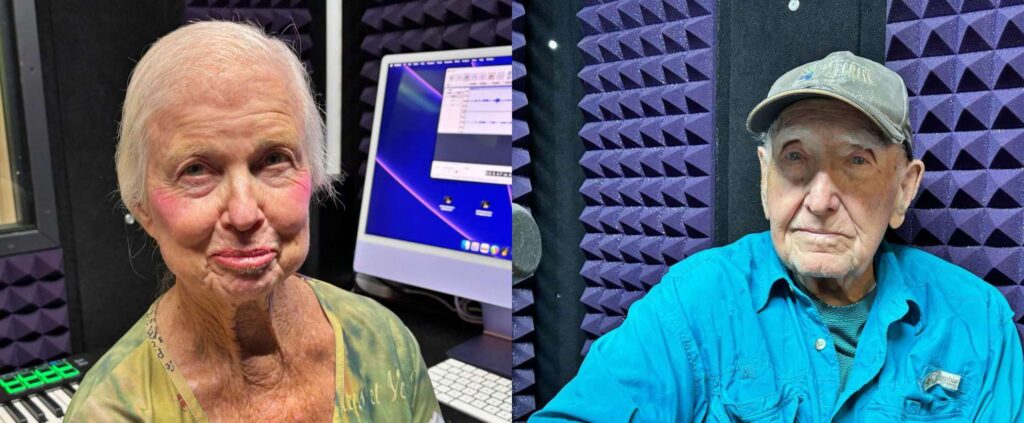
What is your name and call sign?
[Rich]
Rich Carbine. W6UDS. Ugly Duck Soup. And what’s your name and call sign?
[Marilyn]
My name and call sign is Marilyn Bagshaw. November 6. Victor Alpha Whiskey. Very active woman.
[Rich]
Tell me why you decided to be a ham radio operator.
[Marilyn]
In the mid-1980s, my son, who was at Redwood High School and taking a class in electronics, came home one day and said, “Mom, I’m a ham radio operator.” He just went over to San Francisco on a bus, without my knowledge, to the FCC, and took his license and passed. And one day, when he was on his HT in the dining room at home here in Mill Valley, a block away, he said, “Here, Mom, hold this radio. Talk to this guy.”
And he announced his call. And I said, “Oh, hi.” And I had this long conversation with this other ham, and my son left the room. And I got turned on to it and decided to take a test, which I did, which then was up at Hamilton in their red and white checkered building, and became a ham. And then went all the way, got my Novice and an Extra eventually.
And belonging to the Marin Amateur Radio Club is where I met Rich.
Tell me when and why did you get started with ham radio?
[Rich]
My dad had an old SkyBuddy, Hallicrafters radio. Just a radio itself, nothing else. And I got interested, and CB was kind of interesting too.
And being in the electrical field, I decided to be a ham because I knew a couple of people that had ham licenses. And I had to deal with a guy for a beam antenna if I got my license. And so I went to the FCC in San Francisco and got a license.
[Marilyn]
Do you have any personal stories about how ham radio saved the day?
[Rich]
I guess some during the couple wars we had. I’d do some phone patches overseas. Can’t exactly remember where it was now, but I was fairly active in phone patches.
And what about you?
[Marilyn]
Yes. Fortunately, I was available in San Francisco during the Loma Prieta earthquake. We were on a bus coming back home.
And I thought we just went into a chuck hole, but we didn’t. It was the major, major earthquake. And when I got home, I turned on HF and discovered from a friend in Amsterdam that we had an earthquake.
I didn’t know that. I didn’t find it out locally. So I turned on two meters and decided that I would volunteer over at the, I couldn’t go back to work because there was a big crack on the sidewalk down on Financial District.
So I went over with my HT and a mag mount in my little Toyota and worked at Marina Middle School and worked for three days in the city, slept overnight, ate at the Red Cross headquarters, and then passed traffic for three days. And then during the Mount Vision fire, went out to Mount Vision, got in the fire truck, was one of the Skywalker Ranch firemen, and we did a search of all the homes and reported back by ham radio if we found a cat, if we saw a dog, if your house was destroyed. And I was out there for several days.
So I didn’t save the world, but I helped. And ham radio did it for me.
What do you love about ham radio?
[Rich]
I guess everything as far as being able to travel. You know, we had quite a few travel times in various countries and took our radios with us and operated both CW and sideband. Lots.
That was fun. And get to talk to a few people like Barry Goldwater, K7UGA. And he was on frequently.
It started out, first of all, trying to get a license. Like the South Cook Islands, it was easy because all we had to do was go there and go to their office and we’d get a license. The rest of them, like Tahiti, we had to send a request to France, wasn’t it?
[Marilyn]
Yeah, we had to register in France.
[Rich]
And it took about a year to get a license for them. It was a long time. But other places we’ve gone to have been easier.
[Marilyn]
Well, we heard Tonga three times, Tahiti three times, Fiji once, and then we went to Ireland and stroked our call. You didn’t need a license for that.
[Rich]
It was fun doing that. Well, I guess now you can still do the same thing, but the radio, a slingshot and a wire antenna into a tree and that was about it. The first time we operated it from, I guess it was the South Cooks. I sent out a CQ and the whole world came to me. Two worlds came, one Marilyn did it.
[Marilyn]
We were on the air in Tahiti and a caller came back to us and we said, what’s your QTH? He said, well, I’m in Tahiti. And we said, well, where are you? I’m staying at this specific hotel. I said, well, we’re staying there too. And he said, well, let’s just QSY back down to the bar. So we left the radio and went down to the bar. Yeah. That was fun.
[Rich]
I guess the question was, what fun do we have on radio? I met Marilyn at, I guess it was up at San Rafael someplace.
[Marilyn]
It was up on top of San Pedro Ridge. We were operating on Field Day.
[Rich]
This is somebody I’d like to know. And so we got together. And that was it.
[Marilyn]
And he was fixing an antenna on top of a wooden pole up at Hamilton at the red and white tower. And he just walked with his spikes on and continued walking and didn’t even miss a beat and walked right up the wooden pole. And I thought, hmm. Then I found out what kind of antennas he had at home and I thought, he’s got better antennas than I do.
[Rich]
He’s got beam antennas at home.
[Marilyn]
And a 55-foot tower.
[Rich]
It’s a tower that tilts over totally. And it took a while to put that one up. We haven’t been operating as much as we used to. But I guess it was fun then. The people that we talked to all over the world. It was really good.
[Marilyn]
You joined the Marine Amateur Radio Club when Hugh Cassidy was president.
[Rich]
He was the postmaster of San Rafael at one time. And what year was that?
[Marilyn]
1967.
[Rich]
That’s why I say I don’t know anybody in the club that was with me then. So I must have outlived them, I guess.
[Marilyn]
You were president in 1972 and 2000.
[Rich]
We were meeting in San Rafael when Cass was president. And we met at the First Presbyterian Church in San Rafael. And they had a place where we could meet. And then from there I think we went maybe to the Red Cross.
[Marilyn]
Yeah, I was an officer for two years. I think I was a secretary of MARC. And then we were instrumental when we got the clubhouse.
Hi Roberts got the clubhouse when it was moved over. And then Rich created the apartment upstairs. And then I got a grant to have the ADA for the bathrooms. And then my son, other son, had a friend who was a contractor and he did the kitchen. So we got the kitchen and the bathroom instead and the apartment and the apartment rented.
[Rich]
You’d think with the fire department it would be a great place to live but it was a mess – the electrical needed a lot of help. It needed some… just wiring. Being a contractor, I was able to do that and have it without too much trouble. And then we had it rented and it’s making money for us over these years. Yeah, that helped a lot. And so it’s so far been pretty good. I’m a little concerned that once or twice they wanted to put a tower up and maybe a beam antenna – which being a PG&E person – at the time of a 110,000 volt line that was right above it.
And I totally went against all that and I think they were going to do it anyway.
[Marilyn]
Oh, the other thing I was going to say, we are one of the first members of the Pampanito Amateur Radio Club on the submarine.
[Rich]
Oh, right, right. Yeah, we started that. Yeah. In San Francisco, and they still have, I think they still have the- They’re going to move the ship again, but we lost our antennas.
[Marilyn]
I mean, most of them.
[Rich]
I thought they still had the radio in there, but maybe not.
[Marilyn]
They do. They were just on-
[Rich]
…Yeah, they operate…
[Marilyn]
They were just on Ships on the Air.
[Rich]
Yeah.
[Marilyn]
Well, we spend most of our time on CERT and RACES now, so RACES and CERT seem to be merging nicely and so we’re on Tuesday nights, Sunday mornings with the MARS Club and DXing is fun. We like to work as many countries as we can. And we’re not on the honor roll, but we’re on the list of the Northern Cal DX Club of all the countries. We’d like to work more. Work them all.
I was a Burning Ham. In 1999, my son took me to Burning Man in Black Rock Desert. My HF radio, I had an antenna on my car. And out on the Playa, I was there for 30 days. And I passed traffic mainly with the Red Cross for emergency services. And it rained, and it filled my HF radio with water. So I had to take it and dump all the water out. And then I sent it back to the manufacturer. It was a Kenwood. And it was repaired and taken care of. And that was really fun, to be a Burning Ham. And being of some value there.
Oh, we did the Dipsea Race. When we were much younger, we could go to Muir Woods, check everybody in at the Red Cross truck. And then report people who were injured. And then we would hike over to Stinson Beach and pick up the refuse on the trail, if there was any. But we always got there too late to have the picnic. And then we had to get a ride back from somebody.
[Rich]
Yeah, they gave us a ride back.
[Marilyn]
Yeah, that was fun. But ham radio’s been a total big part of our lives.
[Rich]
Yeah, definitely.
[Marilyn]
That’s what we do together the most.
Well, the frustration right now is we have this 55-foot tower. We’re, of course, both way too old to be climbing this tower and getting up on the roof. But we have to replace the element in the stepper antenna. And I think the frustration is that it’s too complicated. I’d like to see something simple. I’d be glad to live in a car with an antenna. I don’t need a big deal because you spend more time taking care and repairing and tuning and adjusting. And these new radios, too, you have to upgrade the software. I forget how long it took us last time to upgrade the software.
What do we have, an Icom 7600?
[Rich]
It seems to be getting a little difficult. We still can turn on the radio and operate it if we want to. But it’s going to be a little bit of time before we get, I guess, a bunch of guys coming over to do the antenna change.
Things have changed, but as far as CW is still the same, which is good, and talking to other people. Some of the people we used to talk to, they’re gone. Goldwater and the people in the islands, Tom Christian and Mutiny on the Bounty guy. Not him, but his family.
[Marilyn]
Well, a lot of my friends can’t understand because I’m a woman, why I’d be interested in ham radio because usually men go into it. When I was at College of Marin, I wanted to be an electrical engineer. I was in the pre-engineering course. Carlton Cherry was my professor who was on the MARS website as one of the hams a long time ago. There were 86 of us in pre-engineering, and he looked at the class and he said, “I would tell you guys a story, but there’s a woman in the class.” I was so shy. I never left Mill Valley where I was born. I was humiliated because I was a woman. I never went through with my electrical engineering degree. I’ve always been involved in ham radio. A lot of times, like in RACES and so forth, there’s only one or two of us women. And I’m so glad to see that breaking out.
Our younger generation growing up is on electronics all the time, texting, emailing, FaceTiming, Zooming, all over the world. As long as you have power, and we’ve always had a generator, you’ll have ham radio. And line-of-sight simplex is what we use for our CERT team where we live are just line-of-sight radios that communicate all over the community. And it’s the only thing we’re going to have if we lose power and our way to use our cell phones and computers and everything. It’s the only thing we’re going to have. It’s for health and welfare calls, and that’s all I took when I went out on the Mount Vision fire was health and welfare two meters simplex. Don’t depend on anything complicated and fancy.
[Rich]
Our repeaters probably would be down in a real emergency.
[Marilyn]
When a member of our Redwood Empire Club traveled to an island recently on his 75th birthday, he put one of the little native children on the air, and when we were camping out of Point Reyes once, I put my sister’s grandson, who’s now a college graduate, on the phone in the car one day. He was sitting on my lap.
So I think to entice other people and young people growing up, put them on the air and say, hey, you’re talking to Asia right now. You know, do you do that on your cell phone? Do you do that on Zoom? Well, not really. Make friends, and then the friends I’ve made on the air, one friend from Australia, actually came, flew, and visited us here, and we showed them around San Francisco, and we met them on the air.
My father was not a ham, but he knew CW because during the war, World War II, he would be out and copying CW and sending back CW out where Golden Gate Bridge, the North Tower is. And then my uncle, my mother’s brother, was a member of the Brass Pounders in San Francisco during the earthquake of 1906. The year my mother was born in San Francisco.
They say if you love music, you’ll love CW. When I was studying for my tests, I was commuting to the city on a bus, and I listened to it on tape in those days, the 1980s. Every time someone put some money in the money changer, it would go ding-ding-ding-ding, and I would hear CW. I liked the CW part of the test rather than the technical part. While Rich built a radio, we took that one. Did we take it to Ireland?
[Rich]
I think we did.
[Marilyn]
Yeah.
[Rich]
We took something somewhere. There was a little radio I built, just CW. You could put it in a suitcase easily.
[Marilyn]
I don’t know what it would be like to travel today with all the radio stuff.
[Rich]
Well, I think that it might have a problem, the way that if you’re bringing wire and something that looks like a bomb or something, it would be kind of difficult to do it. We haven’t done it for a long time.
[Marilyn]
And what’s really weird, I guess when people learn CW, they have the dashes on their index finger, but both Rich and I have our dashes on our thumbs. When we go da-da, da-da, da-da, da-da. I can’t imagine doing it the other way, and it turns out we both did it that way. So, I love CW. And that kind of seems to be in my epigenetics, CW.
Now that we’re getting older, and our hearing is going down, if I want to get Rich’s attention, I go da-da-da-da-da-da-da-da, and then I send his call sign, and that wakes him up.
Recorded on June 12, 2026 in Mill Valley, CA