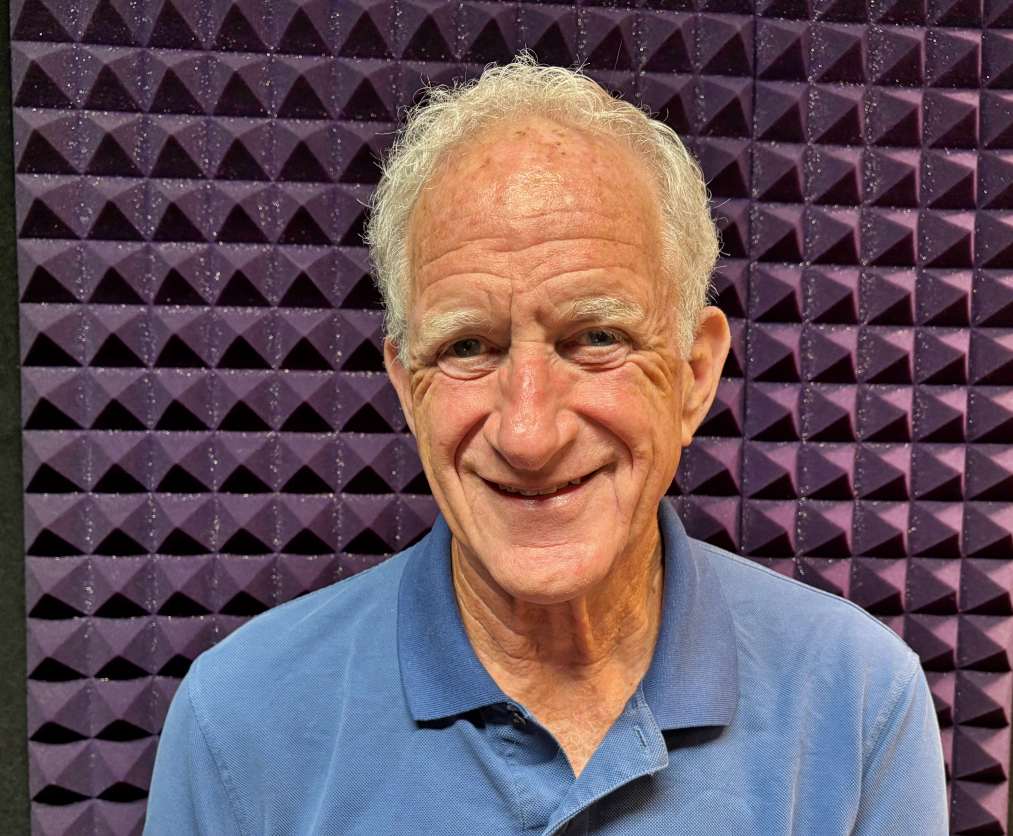
My name is Eric Steinberg, K6ER.
Well, I got started in ham radio, it was 1964. Now, previous to getting started, I had this incredible love for radio, driving around in the car with the 55 Chevy with my family. How can this music come through the air? Asking questions of my father about this and no satisfactory explanation, but I was totally fascinated by it. It was magic.
And then my great-grandfather died and left me his shortwave radio, which was not a ham radio. It was a Zenith table model, a very large radio with many bands on it. To put this in perspective, I was 10 or 11 years old. I spent many hours listening to that shortwave radio and you could get Radio Moscow and Quito, Ecuador, and all these strange sounding things. And it was, again, a magical world for me.
And then I was visiting my grandmother and she had a radio in the kitchen. It didn’t work. Again, 11 years old, and I took it apart, pulled all the tubes out, put it all back together, and it worked. Now, obviously, I didn’t make any repairs. It was probably something dirty that I cleaned off, but I was hailed as a genius. And for my birthday later that year, she gave me a crystal radio kit, which is a very simple radio. And I strung the wire to the garage and put on the little headphones. Little did I know, but I lived about a mile from the local radio station. It came in loud and clear. I remember the very first song I heard, He’s a Rebel by the Crystals, which still brings back those memories.
Moving forward, another year, I was 12 years old and I was walking down the street with my father. And in the community center, there was a sign: “Ham Radio Classes. Get your License. Come Monday night at 7”. My father said, oh, you’d like that. If you get your license, I’ll buy you a radio. I’m there. So, I went to this class, learned Morse code, had five words a minute and got my Novice license in 1963, 64-ish, in that timeframe. My father bought me a radio, actually a transmitter and a receiver. We were living in New York at the time, and I strung illegally this wire out my window to a garage next door and probably made 100 contacts, CW only, on 40 meters and fell in love with Ham Radio. That’s how I got started.
My love of broadcasting, which I morphed into Ham Radio when I was a pre-teenager, ultimately resulted in me being in the broadcast business.
I got my General license later on, and one of my neighbors had this thing called the Cleveland Radio Institute Course in Electronics. HE just brought over a big cardboard box with these things. Simultaneously to that, we moved to Raleigh, North Carolina, and I was in high school. And it turned out that a family friend was a DJ on the local radio station. His name was Charlie Brown. Not his real name. Anyhow, he said, well, come on by for a tour. I was starstruck. To me, these were like movie stars, the local DJs.
Radio was really personality-oriented on the AM, the top 40 station back in – this would have been late 60s. I met the chief engineer there, and he showed me the transmitter, this big awesome behemoth of a rig in the back room there. And I said, well, I want a job here. What can I do? He said, well, if you had a first-class license, I would hire you. Back then, you had to monitor the transmitters closely and record the meter readings every half hour. And at certain power levels and certain types of stations, you had to have someone on duty with a first-class license, which just so happened to be the box of course books that my friend gave me. And I studied that and got that license at – I think I was a senior in high school and got the job. Minimum wage, watching a transmitter.
But I practiced my troubleshooting skills. I was actually working part-time at a radio and TV shop doing TV repair. I was a TV repairman, if you could believe that. Back when you actually fixed those things, now they’re all computer circuit boards and unrepairable in the field. But I used to go with a little tube caddy to go to people’s houses and then worked in the shop. Anyhow, I had those skills, so I was watching the transmitter. Hey, Eric, can you fix this tape recorder? Can you repair the wire in my headphones? And so I had a steady stream of repair jobs. And that was my high school job from sunset to midnight three days a week. And I fell in love with broadcasting.
And after college, I got a job as a director of engineering for a very small radio company based out of Chapel Hill, North Carolina. We had stations there and in Kentucky. Maybe three or four years there, just above minimum wage. And I go, I’m good at this. I’d like to make a career of this. I need to do better.
I saw an ad in Broadcasting Magazine, which was a thing back then, for our chief engineer for ABC, the network, who at that time owned seven AM, seven FM, and five TV stations. The network owned these stations. That was the limit at that time. Now there’s no limit. And one of their stations, an AM and FM group in Houston, and I applied for the job. And I guess I interviewed well. I got it. Moved to Houston. Tripled my salary. And ultimately was with ABC as a chief engineer for 11 years, Houston and Los Angeles. Came to San Francisco as a chief engineer at KGO Radio and engineering manager at Channel 7.
While working there, I met a gentleman named Ed Davis socially. Ed was the owner and manager of KDFC, which is the classical station. And he and I hit it off. We’d have lunch once a month. But then Ed Davis, my friend, died. And I get a call from his wife. She says, Ed said, If anything ever happened to me, call Eric Steinberg. So she called me up. I met with – her name was Helen Davis and her attorney. And they hired me as the General Manager. So I worked as a radio station GM for several years as manager of KDFC. And then the family decided they were going to sell the station for various reasons. And they did. And I had a buyout. And I didn’t want to work with the new owners for philosophical reasons. But that was probably the best job I ever had, working with the symphony. And I love classical music and have that background. My mother played it all during the house when I was growing up. I knew all the decent composers, in my opinion. Anyhow, so I ended up as a manager.
And after that, I kind of got back into radio. I was recruited. People I knew in the business were always calling me, Hey, can you do this? I was recruited as a chief engineer. It was Big 98, KNEW, KABL, and KSAN. And worked there a couple of years. And then they sold. These stations were all changing hands and combining and causing us to move around. And then my last job in broadcasting, I got hired by a company called Susquehanna. And we owned 30 or 40 stations nationwide. Among them, KNBR, KFOG, The Bone, and The Ticket. And I was hired to be the engineering manager for that group of stations. Wonderful capstone to my career. And then they were sold to a company called Cumulus. Again, philosophical differences. Ultimately, they called me back several times as a contractor to make some repairs. And especially the transmitter site out in Redwood Shores. That’s my real love, big transmitters.
And I installed KMBR’s 50 kilowatt hour and the Bones’ digital transmitter for HD and the 50 kilowatter for KTCT. KFOG’s all new solid state. So that’s my favorite thing is installing transmitters and tuning antennas up on Sutro Tower.
And then after that, after I left Cumulus, I’m sitting around the house. My wife sees a job for this thing called Silver Spring Networks. They do the smart grid, smart meter equipment for PG&E. We need a field service tech who can troubleshoot. I go, well, that sounds like fun. I love that. As it turned out, I know someone who is on the board of directors there. I called him up and said, hey, this job sounds cool. He goes, oh, this company is great. Give me your resume. I’ll send it over to him. It angered them. How dare a board of directors tell us who to hire and who not to hire. So there’s this young engineer at Silver Spring Networks. They were in Redwood City at the time. He said, I don’t care if they send Jesus Christ over here. I’m interviewing him, and if he isn’t qualified, he isn’t getting the job, and that’s that. His name was Eli. So they put me in a room with Eli and a whiteboard.
Then Eli starts writing on the whiteboard, a transmitter, how many dBm output, and a transmission line, the loss per 100 feet, how long it was, and the antenna gain, and blah, blah, blah, and an equal sign and a question mark. He goes, what’s the answer to that? I go, Eli, you gave it to me in decibels. It’s an arithmetic problem. It’s 32. He stops, and he goes, I’m so sorry, Eric, but you’re the only one that’s answered that question. And he stuck out his hand, and I got the job there. I worked there for about five years troubleshooting. Then I complained a lot about how these were designed. So I was made the manager of network design. And then the company went public. I had an equity event, and they moved to San Jose. It’s time. It’s time.
When KDFC was sold, going back to wherever it was, 1994ish, thereabouts, I told the family, look, no, no, no, do not sell the land. I’ll manage that transmitter. We had 10 or 12 tenants up there. It’s a steady source of income for you and your heirs. Do not sell it. I’ll manage it. And they go, well, that’s a good idea. You’re in charge. So I went and got a California Real Estate broker’s license. And I’ve been managing that property since then on behalf of the family. And they love it. They love it because, you know, who else has a FCC license, a real estate license, an electrical contractor’s license, knows the family and has 30 years of experience up there. And so I do that.
My favorite thing about Ham Radio is building and troubleshooting. In fact, I have some of the most expensive Ham Radios you can get that have never made a contact. So, that’s my sad story. I love making them, trying them, testing them, measuring them, more than operating with them, although I do a minimal amount of operating. I’m a serial obsessive. I’ll go to digital, for example, or I’ll go to FT8, which is one of the new digital modes, or I’ll try and work all states or do this and that.
My latest thing is QRP, which is operating at very low power. I’ve built several QRP rigs of which I’ve never made a contact with, as I stated before. I’m promising to do that. That’s on my bucket list, actually make a CW contact.
Recorded on September 10, 2026 in Mill Valley