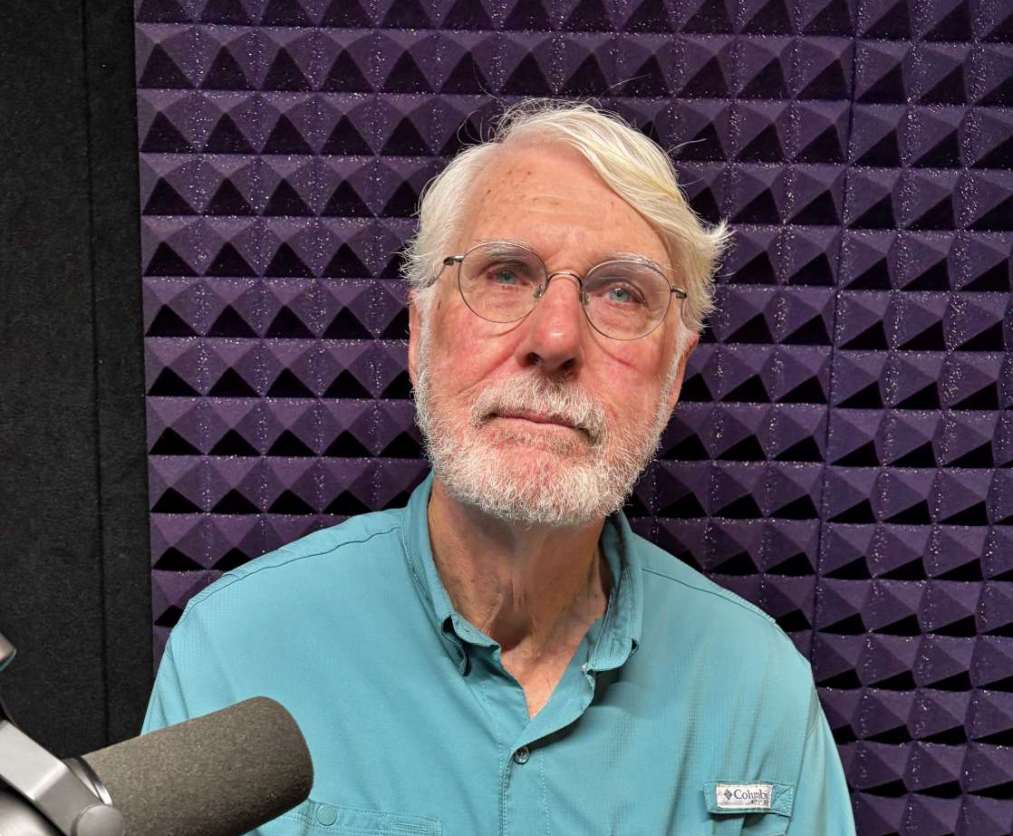
My name is Jim Emrich, callsign N6NRV.
I was a radioman in the Coast Guard. And there were guys who, lifers, you know, guys who went back and re-enlisted, and a lot of them got out after four years, found a job. But they missed the code so much, they wanted to get back. You know, it’s like it gets in your blood. I didn’t want to go back in. Yeah, I got out of the Coast Guard, went to school up at Oregon State, and kept thinking about getting back into ham radio but always got sidetracked.
You know, got out, got a job, got married, the whole deal. And what was it? Eighty-one, I guess. I studied for the General test and took it at the FCC office there in Long Beach and passed it. So I got my license. But then here I was. Now what do I do? How do you get set up, dot, dot, dot, dot, dot? And I was still busy – family. My son was two years old. So the family things going on, the work going on, I was, you know, getting the office established. So anyway, the long story short, so I was back up here in the Bay Area working for Fireman’s Fund. I was in San Rafael. And at lunchtime I went across the street to the shopping center, and they have a Radio Shack in there. And they had an HT-100 – HTX-100 – the 20 meters only.
And I go, oh, a ham radio. And it had the mag mount and the power supply and stuff. So I got it, put it in my minivan. And a friend helped me install that. He worked for PG&E, and that was his job, installing radios in the cars and trucks. So he helped me. Got it in there. And then that was the way I went. You know, I had the mag mount up on the roof, and on the way commuting from Novato to Terra Linda, I’d get on there in the morning and in the afternoon, and sometimes at night after work I’d go out. And then I hooked up a key to it, which, you know, started working CW from my van.
I was in a HRO (Ham Radio Outlet). They used to have a shop in Oakland. And interestingly enough, next door to it, there’s the West Marine store. And then right down the street was the Coast Guard, or Government Island, where I went to boot camp. And this is something I really miss, is going into these places. You know, the HRO is clear up in Sacramento now, just going out looking for stuff. And I was in there and they had a kit for some antennas, 80 meters to 10 meters. I go, oh, that’d be cool. I could get my HT-100 on there. What it was, was a kit to build a dipole, give you a thing of copper wire, a balun, some insulators, and even some rope. So I went out and measured out for 20 meters and put it together and strung it up in the garage from the rafters, put my radio on the workbench and the power supply and started operating from there. And did that for a while.
Then I was in another ham store up in Rohnert Park, a real cool place. It was like the old school ham radio place. And they had shorteners for 40 meters. There were two fat insulators with copper wire wrapped around them and you’d put them in for your antenna so you have room. And so I thought I could put this up in my attic. So I put the whole thing together, went up there. The hardest thing I’ve ever done physically is, you know, our house at least has a peaked roof, but it’s about four and a half feet high or something. And you have to walk on those stringers and not go through them. Anyway, I got up there, strung it, and showed my wife how to use the SWR meter. And so I would, you know, I’d shorten, lengthen one, yell down to her and she would check it. You know, okay, anyway, we went back and forth, back and forth and got them all, got them all lined up. Except for the 10 meter segment, I started messing with that and when I changed it, it would affect the other one. So I go, okay, screw it, I’ll just, you know, leave it. So anyway, that was my, got that set up.
And earlier, much earlier, a friend gave me an Alda 103 transceiver. It was one of the first solid state radios back in the 70s. And it worked on 80, 20, and 40. So I thought, well, I’ve now got the antenna, I can hook this up. And I used the car battery for the power supply and I add – down at the old war surplus place there on Bellam in San Rafael. That’s another cool place. I was in there and got some stuff. Anyway, one day I bought a small motorcycle battery charger. And so I hooked that up to the battery and then the radio up to the batteries, that was my power supply. So I was on 40 meters with that antenna. But we didn’t have the microphone. So I didn’t need it, I used it for CW. So that was my 20 and 40 meter band radio. And then I had my HT100 for 10. So I operated that way for a while.
And an interesting side story, I had the Alda 103. I thought, gee, I need a manual for this. And so I put an ad in QST, in the back they have those ads, and they’re actually pretty ridiculous. It’s all “rent someplace” and/or “QSL cards” and I put an ad and I said, does anyone have a manual for an Alda 103? And I got about seven or eight responses. And this is back when you get mail. And anyway, it was interesting, people wrote back, yeah, I can do that. One guy, he wanted a bunch of money for it, but everybody else was real. And so this one guy sent me the entire manual, photocopy of them, even the schematics. It was interesting to get feedback from all these Alda 103 users, like I had a little club. So anyway, after a while operating the Alda and my HT 100, I had time to grow up and get real. So, I went over to HRO and bought an ICOM 727/37. And then I had everything all set. All I had to do was take it out of the box, plug it in and I was on the air.
There’s a net that I would check into the ZUT, it’s a Coast Guard, a bunch of retired Coast Guard radio men. Another side story, ZUT stands for CW Forever. You know, hams use Q signals, QRU, QSL. The military uses Z signals. And so, as a Coast Guard radio man, you have to be bilingual. You have to use both. And there are a ton of Z signals because they use them like in aviation. You know, I’m above a cloud, I’m below a cloud, and da, da, da, all this stuff that’s for the operators that are on the planes. During World War II, torpedo bombers, they would have a gunner and radio man inside – which I can’t imagine doing. Back in the sixties, Coast Guard started putting radio teletype on some of their cutters and there was this chief and he was worried that they were going to eliminate CW. So he started this kind of a club called ZUT, which stands for CW Forever. And so anyway, years later, they kind of reactivated it.
And now there’s a net every Thursday morning at 8.30, a guy up in Port Angeles is the net control and everybody sends their call sign, you know, trying to, and then he sends back. Here’s what I have, all the call signs, if yours is not there, then you send again. Anyway, then he goes down the list and everybody sends a message mostly about the local weather and sometimes they’ll throw in something interesting. Some guy could record it and you could go online and listen to it. I listened to myself and I sounded terrible. It turned out there was a defect in my Icom, which I’ve been using for years. I found a guy up in Sacramento who would repair radios. Yeah, there’s something wrong, but he could not find a new circuit board for it. And he tried all over. So I ended up buying another radio, an ICOM, a 718. I love the old one, but it just wasn’t working right. So that’s my new one.
You know with CW – there’s a connection. You get a thing going back with somebody on the other end, it’s like you’re almost immediately you’re a friend. You know, you’ve just got this common bond of CW. So that makes it fun. I really admire people. You know, I went to radio school, had to learn it. You know, they taught us. People that learn it on their own, I’m really impressed that they can do that because I know it’s a tough job.
But if it wasn’t for CW, I wouldn’t be in ham radio.
Recorded on July 3, 2026 in Mill Valley, CA