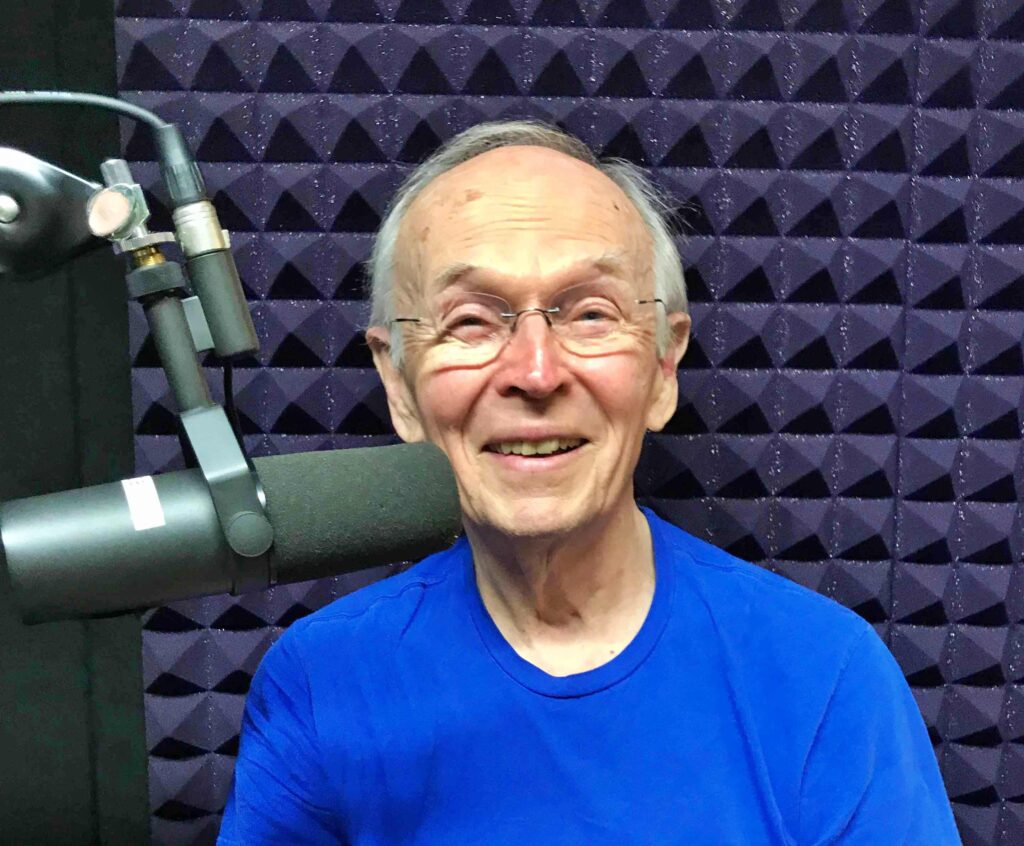
I’m Michael Fischer, K6MLF.
Well, in one town we lived in, Biloxi, Mississippi, we lived in a really small ratty home right next to the railroad tracks, the Louisville and Nashville Railroad tracks.The house would shudder, shake at all hours. Our next door neighbor was a ham. His ham shack was literally that, a shack, a tar paper shack. Dark, windowless, really noisy when the trains came rumbling through. The inside walls were covered with QSL cards. I can still see them posted at crazy angles with rusty thumbtacks. He was delighted to have me, a wide-eyed, curious five-year-old kid, sit and listen to his stories and listen to the hiss and crackles and distorted voices and CW signals.
Then at age 10, five years later, we moved to San Antonio, Texas, out of the South into the Southwest. Once again, there was a crusty, elderly, to me anyway, ham with a similar but somewhat less flimsy ham shack, QSL cards hanging all over the walls, oscilloscope flickering, the smell of the ozone from the heated vacuum tubes in the hum of the amplifier, and listen to his stories about the stations contacted far, far away. Magic, mesmerizing, 1950, think of that. Air travel for poor people, not even imaginable. To be able to talk to people in other continents, a magic carpet couldn’t have been more magic.
So my interest in ham radio started then, and like many people, it stopped then for a while. Oh, when my brother learned that I had gotten my license 18 years ago now, he said, well, Mike has always wanted to be a ham ever since he was a kid. This must be his second childhood. So, second childhood or not, when I was newly active in CERT, the Community Emergency Response Team, I had assumed that ham radio would be a contribution to CERT activities. I was mistaken. The Mill Valley and Southern Marin CERT teams don’t use ham radio at all. But I got my license, and within a week or two, I was a member of the Marin Amateur Radio Society, and CERT stuff kind of disappeared, and other options sprang up.
You know, during the public service events, maybe a third of the time, somebody will be injured or ill, or somebody else on the trail not in the event will also have some sort of medical emergency.
Well, at the end of the Miwok 100, which was – Miwok 100 is often run in the first of May, and strangely enough, wild storms occur on the first week of May. And this was toward the end of the race, so it was after dark. 100K race. And coming down the hill, a woman suffered basically a runner’s chemical attack. Her liver failed. And it was not – it’s a race. So other people saw her fall on the trail, came down, and reported it at the finish line. Well, it wasn’t exactly clear exactly where this occurred, but it was on the final downhill stretch.
So one of our radio operators started hiking up the trail, and the emergency response guy with his ambulance hollered, Hey, Michael, get in here with me. Tell me how to go. So I was on the radio in the ambulance and made it to the bottom of the trail just as she was being carried down. So we were able to effectuate the quickest connection between a woman in some distress and the ambulance. That’s an example. It was the end of a long day, which had started at 6 in the morning, so all of us radio operators had been soggy wet and operating for more than 12 hours.
But it was an example of the event had no emergency at all until the last 10 minutes.
I’m a people kind of guy, not a gear kind of guy. And so I have buddied up with Randy Jenkins and co-organized the public service teams with him for five or six years before he phased out. And for the last five or plus years, I’ve been good friends with Rob Rowlands. And Rob is a guy who chases after the latest shiny thing. And so to give him partnership, I’ve run along in his wake buying this sort of stuff, this latest shiny thing, saying to myself, but not to him, why? Why am I doing this? But it’s because of friendship and people. I just admire the heck out of Curtis, for instance, another people sort of guy. Yes, I enjoy being on the radio.
And, you know, I have a logbook, and I keep them by hand. And I think I’ve amassed something like 10,000 contacts. This is all HF stuff. I don’t log the UHF, VHF stuff. And for decades, I’ve been a member of the Mission Trail traffic net. Well, since cell phones really became ubiquitous and even old doddering folks know how to use the text, there’s very little demand for written traffic on the radio. And, indeed, many of the traffic nets have gone out of business. Not the Mission Trail net, known as the friendly net. And, indeed, it’s just the personal connection with those voices over the air from Tehachapi up to Darby, Montana, and over to St. George, Utah. Over the decades, you get to know the voice, get to know a little bit about it. The monthly newsletter indicates anniversary dates and birth dates. And every now and then, somebody will write up a little piece about himself or herself.
Again, well, my other friend, Til Mossi, W6CQC, whom I met at Spreckels Lake. Til is in his early 90s now. Former owner of the Paladini Seafood Market, Fisherman’s Wharf, and he used to own a fleet of fishing boats. Well, he suffered a major stroke a couple of years ago. But he does have a radio in his rest home, and they allowed him to put an 80-meter NFED dipole up on the roof. And he said to me a couple of months ago, he said, Thank God that you put me in touch with the Mission Trail Net. It gives me something to do every night. And they recognize who I am, and I recognize them. So it takes him out of his assisted care facility and into the world.
Not much frustrates me about ham radio, actually. I tend to dive into DMR and then say, Well, this isn’t for me. But I don’t get frustrated about it. I don’t get irritated about it. And if other people want to pursue DMR, even though it’s not for me, cool, let them go. What frustrates me? I guess the only thing that really frustrates me, and I’ve cured it, is sitting in meetings and listening to people wander off topic and then want to talk about other things. And then somebody will come back to the agenda, and off topic we go again. mOr, Are you sure we ought to be spending this $32? And so, again, I don’t get angry. I don’t get upset. I don’t get frustrated. I just don’t go to the meetings. So I can’t think of anything that really frustrates me.
What are the common misconceptions about Ham Radio? I think the most common one is the vision of portly, let’s call it, older men, not women, smoking cigarettes in a somewhat messy radio place in their garage or attic. And exchanging all sorts of code-laced words like QST or, yeah, QRZ. And so it’s seen as an arcane, archaic, and fusty enterprise. It’s not true, always. Some part of that’s true, but you just take a look at the public service events and see people in their 20s, in their 30s, in their 40s, and go to any of our Critical Mass radio meetings and you’ll find at least a third of the people there are women and women under 50. And that’s the reality of ham radio. So it’s diverse, it’s energetic, it’s got utility in public service and utility in emergency communications.
Why not come try ham radio? You don’t have to buy anything. Just come to the Marin Amateur Radio Society clubhouse and you’ll find somebody like me who will say, hey, who are you? Interested? You want to buddy with me at the next public service event? You want to go into the back room and let me show you the radios? So there’s an open door. That said, there are people in high school and perhaps college who’d be very interested for a while. But as with most nonprofit or most hobbies, there’s a big peak in the high school and college age which drops to almost zero until a person turns 45. And so the expectation that people between the ages of 20 and 45 would be really interested and able to deliver a lot of hours, that’s foolish thinking. That’s not going to happen. So if your objective is to encourage people to be active in ham radio, don’t go running after the demographic that just isn’t going to do it. Do go running after the college age kids because when they turn 45, many of them will then come back to it. But don’t expect them to be active after college. And so, to open the door to ham radio to make them see that it’s something that they would like to be engaged in is to do what we do at The Critical Mass, provide little glimpses into the many different facets of ham radio. Some people are really interested in contesting. Most are not. Some people are really interested in the latest weather balloon that’s going to carry a ham radio to be tracked across the Western states. Most are not. So it’s not reasonable to expect that everyone is going to be interested in every aspect of this, let’s call it sport. It is a sport.
It’s a community service endeavor. So I think the largest percentage of people who are likely to be interested in ham radio are going to come in, as I did, through the emergency communication. Is this going to help my family in the earthquake? And the answer is yes, possibly.
Oh, and another story I wanted to share is again about emergency communications . Standing behind the police department four or five years ago with Rob Ireson, the head of RACES, the Radio Amateur Civil Emergency Service, formerly under the Sheriff’s Department, now under the Office of Emergency Management. Anyway, the RACES emergency radio is in the police department. And in an emergency, ain’t going to be anybody in there. All the cops are going to be out on the beat or rescuing people out of collapsed buildings. And so there’s not going to be any access to those radios by the amateur radio community. Just so happened that the Mill Valley CERT had a trailer that had been fitted out to be a radio station with desks and batteries and solar panels, et cetera. And I said to Rob, hey, how about if we move the RACES radio out here to the trailer where we can get access and can provide communication between the fire department and the Office of Emergency Management? Oh, he said, no, no, that won’t work. Oh, really? Nope. It’s got to stay in the police department. Oh, really? Okay. So click, click, click goes my head.
And I said to the then fire chief, Tom Welch, hey, Tom, what if I put together a radio team just for the city of Mill Valley? Cool, he says, try it out. I said, well, my first step is going to be to send a letter from you to all of the registered hams in Mill Valley, about 150. Surprisingly enough, I mean, that’s the total membership of the Marin Amateur Radio Society, right? How many of those 150 are members of MARS? 10, 15 maybe? Okay, that’s 10%. Not a bad percentage, actually, when you look at things. But so Tom sent out the letter to all 150. Are you interested in helping as a radio operator to communicate between the neighborhood response groups and the fire department?
And 15 people, none of whom was a member of MARS, indicated interest. There are two doctors and two lawyers and a professional photographer and a psychiatrist. So nobody with a big ham radio experience. To a person, those 15 said, you know, I used to be active as a radio operator. This gives me an opportunity to get active again. Well, of those 15, at first, five clearly enjoyed each other’s company. So I called them the five Gs, the five gents. And we started a monthly luncheon at Piatti Restaurant. Not an inexpensive enterprise, ends up costing 40 bucks a piece for lunch. And it’s now grown to 10 people, which we still call it the five Gs. Those 10 people and the attendance at those monthly meetings is usually 10.
This coming month, it’s going to be six because four of them will be in Europe. It’s that part of the demographic selected from Mill Valley. But the fact that these…now, these 10 folks, we’ve gone together to Sweetwater because one of us, Eric, plays the guitar. We wanted to see Eric playing the guitar. So here’s Eric in this noisy place with a couple of tables of ham radio operators watching him play the guitar. Another one of our members, James Renney, has a just totally incredible home theater. He’s a retired sound engineer. And the group of us has now gone to his place for dinner and a movie. And so it’s not just radio, it’s people meeting each other and having a spark of shared experience. But from the shared experience of radio, it’s gone to, you know, one of the movies that we saw was Porgy and Bess. You know, what’s radio about that? Nothing. But it involved the wives as well. So the families of these 10 are now good friends. Mark Steiner and his wife are Siennophiles. She spends a couple of weeks, if not a couple of months, in Sienna each year. And Jane and I have happened to have spent the full week of the Palio in Sienna. So we share stories. I can’t believe somebody else knows this much about Sienna.
And so again, started out with Tom Welch sending a letter. And by the way, the team is…I have withdrawn from the team because at age 86, Jane says, in an emergency, you ain’t deploying anywhere. You’re sticking with me. Okay. So I’m no longer on the team. That’s cool. The team is still there and still practicing.
I guess the one other story I would tell is how did our Critical Mass get started? Well, one of my other advocations is sailing model yachts and racing model yachts. As a matter of fact, I’m writing an article for Latitude 38 right now, which is the monthly mag for big boat sailors in the Bay Area, trying to encourage them to see the value of getting involved in model yacht racing. You can race 12 heats in two hours. Try doing that with your big boat, sorry. Maybe one, maybe two, and you’re going to have to round up a crew. So model yacht racing is great practice for big boat sailing. End of that pitch.
How did Critical Mass get started? I’m at Spreckels Lake. It’s raining. And so I go into the boathouse. I look over to the northwest corner of the lake, and here’s a group of ham radio guys with their HTs huddled in the rain. So I go over, and clearly there’s one guy in charge. I go over and I say, hey, my name is Michael, K6MLF. Oh, yeah, I’m Peter, AA6SF. Oh, hi, Peter. Why are you guys standing out in the rain? Come on into the boathouse and have your meeting. Oh, could we? Sure. And so we opened up the boathouse, and I got to be great friends with Peter.
One of the things that he ran was the weekly Siren Net in San Francisco, which is now no longer going. But he needed net control operators for the Siren Net. I became one of his net control operators, half of the time from Mill Valley. So I had to say, well, somebody tell me when the siren… So anyway, Peter and I did lots of things together, he and his wife, and Jane and mine. And so I participated and watched him run the Critical Mass, and I said, hey, Peter, it’s a really tough thing to get Marin people over the bridge. How about us setting up a North Bay Critical Mass? He said, great, I’d be glad to help. And he actually wrote up a bunch of funny written messages to pass for us and a bunch of other suggestions. And he attended maybe half of the sessions for a couple of years. Peter’s now passed away, but it was Peter’s instinct. He created the Critical Mass in San Francisco, and he was ready to help us replicate it in Marin. Without Peter, without my friendship with Peter, the Marin thing wouldn’t have happened.
Okay. One other story. The leadership that Scott is exhibiting running the public service events is remarkable because unlike my mentor and predecessor, Randy Jenkins, who did it all alone, and I happened to be in the meeting when he stood up and said to the board, I can’t keep doing this all alone. And I said, well, I’ll help. So Randy and I ran the public service events until his illness, and then I ran it for a couple of years, and then finally dragooned Rob to help me run it. Well, Scott has a different model altogether. Scott is just collaborating and coordinating with Oliver, with Rob, with me, and with Don. So now there’s a team of people who are knowledgeable about how to run public service events. I go away.
It’s still running. Rob goes away. It’s still running.
So that’s a wonderful, much more sustainable way of running things is to have a team. So when one falls off…the next person takes over.
So that’s another story of how public service process has evolved.
Recorded on February 27, 2026 in Mill Valley